德国HYDRO-BIOS公司—多通道水样采集器
Multi Water Sampler
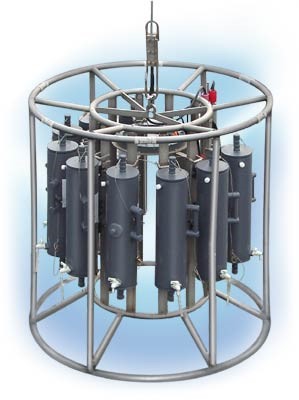
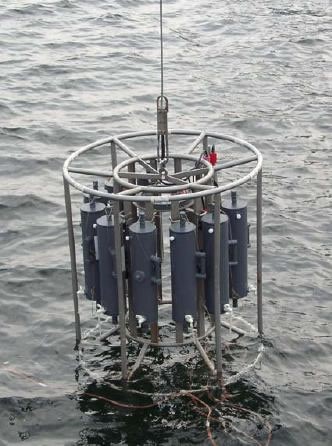
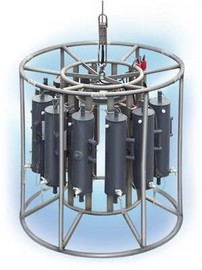
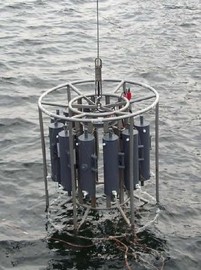
MWS多通道水样采集器用于在水体中进行水样分层采集工作。它由一组坚固的、装有12/24个支架的不锈钢阵列组成,支架上可以安装容量为1.7L或10L的采样瓶,用来在一次操作中完成12/24个不同深度水样的采集工作。多通道水样采集器装有一个马达驱动的自动释放装置,上面集成一个压力传感器,传感器的测量范围可根据用户的工作要求进行选择。工作水深:3000米,6000米,11000米。整套系统工作时电量消耗极少,并且可以在温度为-40℃~+85℃的极端环境中正常工作。
MWS多通道水样采集器可以由甲板控制单元上的控制按钮控制,进行在线实时采样;也可按照预先设定的采样深度间隔进行离线自容式采样。
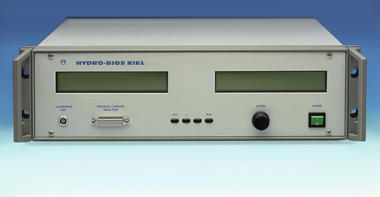
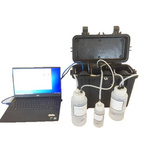
多通道水样采集器控制单元
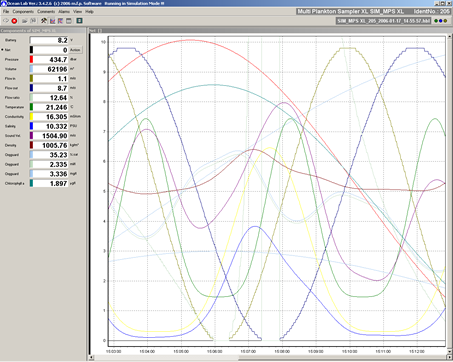
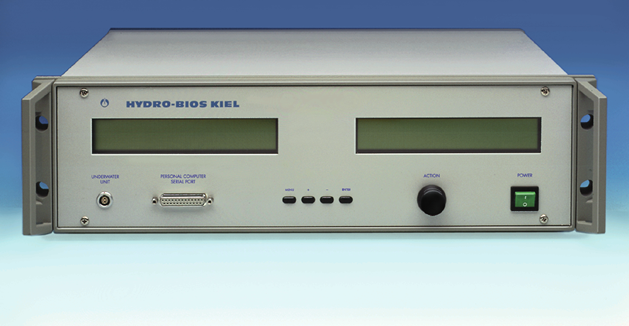
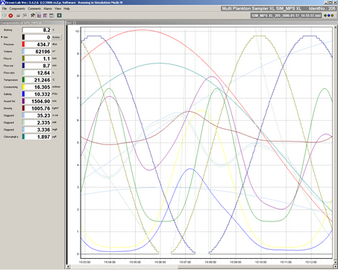
OceanLab数据处理软件 甲板单元
选配件:
CT-组件,完全整合在多通道水样采集器的驱动单元上,由一个电导率传感器、一个温度传感器和一个电路板组成。
各种参数的传感器,如温度、盐度、叶绿素、浊度等
容量16M为数据存储器
技术参数:
尺寸 | MWS12:直径,高度160cm;MWS24:直径180cm,高度 |
空重 | MWS12:约(不带采样瓶);MWS24:约200kg(不带采样瓶) |
操作水深 | 标准配置:3000米;可选配置:6000米,11000米 |
阵列 | 不锈钢材质 |
马达单元 | 由钛制成,电池供电(3×DL/3V) |
甲板控制单元 | 金属舱室;带一个控制采样器开关的按钮;显示采样瓶序号、压力和电池状态带发光二极管背景灯的液晶显示屏;与PC机的接口为RS232;由85-260V交流电或电池 |
压力传感器 | 0-3000dbar±0.1%f.s.(标准);0-6000dbar±0.1%f.s.(可选);0-11000dbar±0.1%f.s.(可选); |
独特之处:
√操作简单
√双向通信
√工作水深:3000米,6000米,11000米
√长距离(>)遥感数据传输
√电量消耗极低
√水下单元有电池操作,电缆中电压仅有5V
√电子单元可在温度为-40℃~+85℃的环境中正常工作
√获CE国际质量管理标准体系认证,高品质保证
MWS多通道水样采集器订购信息:
436 912 MWS 12多通道水样采集器
带微处理器和外置电池组的马达驱动单元;
集成压力传感器;
通过PC机控制的可编程式深度依赖性采样间隔;
16兆数据存储器;
带甲板控制单元,85-260V交流电或电池供电;
可安装采样瓶:12只单独订购)
436924 MWS 24多通道水样采集器
带微处理器和外置电池组的马达驱动单元;
集成压力传感器;
通过PC机控制的可编程式深度依赖性采样间隔;
16兆数据存储器;
带甲板控制单元,85-260V交流电或电池供电;
可安装采样瓶:24只,1.7~10L(注意:采样瓶需单独订购)
HYDRO-BIOS多通道水样采集器代表文献:
1.Gradinger, JiirgenLenz,1989.Picocyanobacteria in the high Arctic.Marine Ecology. Progressseries.52:99-101.
2.R. R. Gradinger, M. E. M.Baumann,1991.Distribution of phytoplankton communities in relation to thelarge-scale hydrographical regime in the Fram Strait.MarineBiology.111(2),311-321.
3.R. J. Gowen, B.M. Stewart, D.K. Millsand P. Elliott,1994.Regional differences in stratification and its effect onphytoplankton production and biomass in the northwestern Irish Sea.Journal ofPlankton Research.17(4):753-769.
4.R.J. Gowen, G. McCullough, M.Dickey-Collas and G.S. Kleppel,1997.Copepod abundance in the western Irish Sea:relationship to physical regime, phytoplankton production and standing stock.Journalof Plankton Research.20(2):315-330.
5.K. Richardson, S.H. Jónasdóttir, S.J.Hay, A. Christoffersen,1999.Calanus finmarchicus egg production and foodavailability in the Faroe–Shetland Channel and northern North Sea:October–March.Fisheries Oceanography.8(1):153–162.
6.M. Trimmer, R. J. Gowen, B. M.Stewart, D. B. Nedwell,1999.The spring bloom and its impact on benthicmineralisation rates in western Irish Sea sediments.Marine Ecology Progressseries.185:37-46.
7.Harri T. Kankaanp??, Vesa O. Sipi?,Jorma S. Kuparinen, Jennifer L. Ott, and Wayne W. Carmichael ,1999.Nodularinanalyses and toxicity of a Nodularia spumigena (Nostocales, Cyanobacteria)water-bloom in the western Gulf of Finland, Baltic Sea, in August1999.Phycologia.40(3):268-274.
8.Andrea M. Sass, Henrik Sass, Marco J.L. Coolen, Heribert Cypionka, and J?rg Overmann,2001.Microbial Communities inthe Chemocline of a Hypersaline Deep-Sea Basin (Urania Basin, MediterraneanSea).Applied and Envioronmental Mcrobiology.67(12):5392-5402.
9.Victor W Truesdale, Günther Nausch,Alex Baker,2001.The distribution of iodine in the Baltic Sea duringsummer.Marine Chemistry.74(2–3):87–98.
10.Ann K. Manske, Jens Glaeser, MarcelM. M. Kuypers and J?rg Overmann,2005.Physiology and Phylogeny of Green SulfurBacteria Forming a Monospecific Phototrophic Assemblage at a Depth of 100Meters in the Black Sea.Applied and EnvioronmentalMcrobiology.71(12):8049-8060.
11.Maik Inthorn, Michiel Rutgers van derLoeff, Matthias Zabel,2006.A study of particle exchange at the sediment–waterinterface in the Benguela upwelling area based on 234Th/238Udisequilibrium.Deep Sea Research Part I: Oceanographic ResearchPapers.53(11):1742–1761.
12.Tim J. Waite, Victor W. Truesdale,Jon Olafsson,2006.The distribution of dissolved inorganic iodine in the seasaround Iceland.Marine Chemistry.101(1–2):54–67.
13.MAJANEVA Markus, AUTIO Riitta,HUTTUNEN Maija, KUOSA Harri, KUPARINEN Jorma,2009.Phytoplankton monitoring: theeffect of sampling methods used during different stratification and bloomconditions in the Baltic Sea.Boreal environment research.14(2):313-322.
14.Bertics, Victoria J., L?scher, C. R.,Salonen, I., Dale, Andy W., Gier, Jessica, Schmitz, R.A. and Treude,Tina,2013.Occurrence of benthic microbial nitrogen fixation coupled to sulfatereduction in the seasonally hypoxic Eckernf?rde Bay, BalticSea.Biogeosciences(BG).10(3):1243-1258.
15.W. DAVISON,1977.Sampling and handlingprocedures for the polarographic measurement of oxygen in hypolimneticwaters.Freshwater Biology.7(4):393–401.
16.Austin B. M. Egbore,1978.Seasonalvariations in the density of a small West Africanlake.Hydrobiologia.61(3):195-203.
17.Dr. U. Zaiss, P. Winter, H.Kaltwasser,1982.Microbial methane oxidation in the River Saar.Journal of BasicMicrobiology.22(2):139–148.
18.V.F. Samanidou & I.N.Papadoyannis,1992.Study of heavy metal pollution in the waters of Axios andAliakmon rivers in northern Greece.Journal of Environmental Science and Health. Part A: Environmental Science and Engineering and Toxicology.27(3):587-601.
19.Nilgün Kazanci, Reiner-Hartmut Plasa,Eike Neubert & Afife ?zbirak,1992.On the limnology of Lake K?ycegiz (SWAnatolia).Zoology in the Middle East.6(1):109-126.
20.Eduardo González-Mazo, Jesus MaríaForja, Abelardo Gómez-Parra ,1998.Fate and Distribution of Linear AlkylbenzeneSulfonates in the Littoral Environment.Environ. Sci. Technol..32(11):1636–1641.
21.V.M León, E González-Mazo, AGómez-Parra,2000.Handling of marine and estuarine samples for the determinationof linear alkylbenzene sulfonates and sulfophenylcarboxylic acids.Journal ofChromatography A.889(1-2):211–219.
22.Claus-Peter Stelzer,2001.RESOURCELIMITATION AND REPRODUCTIVE EFFORT IN A PLANKTONICROTIFER.Ecology.82(9):2521–2533.
23.Udo Noack, Thomas Geffke, RamaniBalasubramanian, Jutta Papenbrock, Mike Braune, Dirk Scheerbaum,2004.Effects ofthe Herbicide Metazachlor on Phytoplankton and Periphyton Communities inOutdoor Mesocosms.Acta hydrochimica et hydrobiologica.31(6):482–490.
24.L. R. Rodríguez-Gallego, N. Mazzeo,J. Gorga, M. Meerhoff, J. Clemente, C. Kruk, F. Scasso, G. Lacerot, J. García,F. Quintans,2004.The effects of an artificial wetland dominated byfree-floating plants on the restoration of a subtropical, hypertrophiclake.Lakes & Reservoirs: Research & Management.9(3-4):203–215.
25.Kristina Samuelsson, Johnny Berglund,and Agneta Andersson,2006.Factors structuring the heterotrophic flagellate andciliate community along a brackish water primary production gradient.Journal ofPlankton Research.28(4):345-359.
26.George Kehayias, Ekaterini Chalkia,Stavroula Chalkia, George Nistikakis, Ierotheos Zacharias, AnastasiosZotos,2008.Zooplankton dynamics in the upstream part of Stratos reservoir(Greece).Biologia.63(5):699-710.
27.MAJANEVA Markus, AUTIO Riitta,HUTTUNEN Maija, KUOSA Harri, KUPARINEN Jorma,2009.Phytoplankton monitoring: theeffect of sampling methods used during different stratification and bloomconditions in the Baltic Sea.Boreal environment research.14(2):313-322.