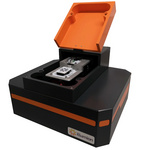
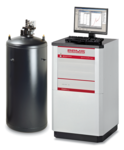
无液氦超导磁体低温系统-TeslatronPT
TeslatronPT提供了一个灵活、多用途的低温与强磁场实验平台。丰富多样的实验插杆使您能够根据应用需求来配置测量系统,例如二维材料、纳米结构和超导器件的研究。
TeslatronPT具备持续升级能力——可通过增加3He 制冷机插杆,将温度进一步扩展至低至300mK,还可通过增强测量与控制功能,将系统提升至我们的TeslatronPT Plus 开放式架构测量系统。这意味着您的科研资金投入将获得长期保障,您的系统能够随研究项目与经费状况的变化而不断适应、扩展和成长。

为什么选择TeslatronPT?
集成变温插件(VTI),样品周围有静态交换气,可提供带磁场的1.5到300 K的样品温度
50 mm大样品空间,可容纳材料样品及各种器件
交换气体冷却意味着样品空间与VTI冷却回路物理分离,避免冷却回路污染风险或需要样品杆装载过渡装置
多种标准磁体可选,磁场高达14 T,同时提供矢量旋转磁体
细丝Nb3Sn超导线通过减小剩磁实现最小场滞,并减少低场下的磁通跳跃
可选更低温度插杆,最低可达300 mK
低噪声、带ESD保护的测量插杆
主要参数
磁场选项:8 T、12 T、14 T 和6/1/1 T 矢量旋转磁体
样品空间直径:50 mm
温度范围:1.5 - 300 K
温度稳定性:±50 mK
样品冷却时间:基础样品杆从室温降到低于2K 小于2 小时(装载到冷VTI 中)
升级控制电子设备与控制软
TeslatronPT配备升级版控制电子设备以及我们的跨产品DECS 控制软件。通过引入现代化、统一的控制平台,以实现更优的操作性、远程访问能力和未来可扩展性。
远程控制与访问:通过DECS 远程界面,您可以从任何地方监控和控制系统。除气体处理和样品更换外,日常操作无需人员亲临现场。
系统集成的统一API:一个统一的API 即可控制整个系统。无需为每台仪器分别安装驱动程序,通过单一接口即可集成您的实验。
自动记录与实时仪表盘:作为标准配置提供,既用于研究数据采集,也用于远程服务与诊断。
成熟且受支持的平台:DECS 软件平台在整个产品家族(TeslatronPT Plus 和Proteox)中通用,这意味着一致的技术支持、熟悉的操作方式以及长期的延续性。
样品杆和样品托
低噪声、防静电的通用测量样品杆,与低温恒温器电气隔离
标配屏蔽双绞线,可额外选配带主动屏蔽三同轴接口的屏蔽双绞线
使用氮化铝材质的PCB和LCC样品座,具有极高的热导率。
可选配如下样品架,支持平行或垂直于磁场方向安装:
配有ESD接口的20针LCC样品座
配有ESD接口的16针DIP(双路直插式)样品座
44针LCC样品座
在将样品装入样品盒的过程中,ESD插座将所有连接到样品上的引线连接到一起,从而确保不会因为静电放电产生流过样品的电流。
- 可选静态交换气样品环境中或真空环境中两种配置
- 提供基础版样品杆作为标准配置,供用户自行改装适配
灵活升级,满足多样化需求随时根据需求升级更多功能:
随时升级HelioxVT 功能:集成的DECS 软件控制模块使HelioxVT 系统集成变得简单直接——必要的控制基础设施已预先部署到位。
随时升级测量功能:该平台已为全面的仪器集成做好准备。您可以在研究需要时随时添置带有测量功能的测量机柜。
我们提供一系列灵活的测量和自动化升级方案,以满足您的特定需求,优化您的项目预算。
如需了解我们集成的开放式架构测量系统,请访问我们的TeslatronPT Plus 页面。
量子反常霍尔效应
1.拓扑绝缘体能在其表面表现出无损导电性,这可能实现更高效的电子器件。
2.拓扑保护的量子态也可以用于容错量子计算。
3.作者研究了由本征磁性拓扑绝缘体锰铋碲(MnBi2Te4)制成的五层单晶中磁场诱导的量子反常霍尔效应(QAHE)。
4.作者使用TeslatronPT调节磁场和温度的过程中测量了纵向(Rxx)和横向(Ryx)电阻。
5.这是首个展示量子反常霍尔效应的本征磁性拓扑绝缘体。

Deng et al Science 21 Feb 2020: Vol. 367,Issue 6480, pp. 895-900
三维量子霍尔效应
1.作者报道了首个三维量子霍尔效应(3D QHE)的明确实验证据。
2.使用体块ZrTe5晶体实现所需的超低载流子密度和超高迁移率。
3.在1.5特斯拉的磁场下,他们测量到无耗散的纵向电阻率和建立的霍尔电阻率平台。
4.在更高磁场下,他们发现了金属-绝缘体转变,代表了一种新型的由磁场驱动的量子相变。
5.使用带机械旋转杆的TeslatronPT在低至1.5K下进行了测量。使用HelioxVL在低至260mK下进行了测量。
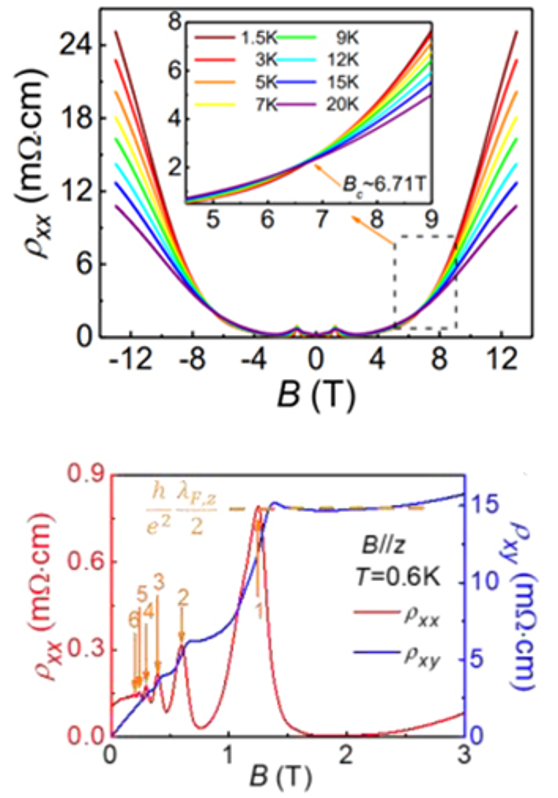
Tang et al Nature volume 569, pages537–541(2019)
使用扫描SQUID显微镜的边缘超导性
1.理解边缘超导性对于未来在超导自旋电子学和拓扑量子计算中的潜在应用至关重要。
2.作者在TeslatronPT上安装了带有附加振动阻尼的扫描SQUID显微(SSM)探头。
3.作者对超导Fe(Se,Te)中的超电流分布和局部超流密度进行成像。
4.研究发现体相超导性显著受抑,而边缘仍保持强烈的超导抗磁性。
5.超流密度和超电流分布的温度依赖性在边缘和体相之间表现出明显的差异。

Jiang et al Science Bulletin Vol. 66, Issue5, 15 March 2021, Pages 425-432

图1 通用测量样品杆(样品在气态环境中)装在冷的变温腔(VTI)中

图2 变温腔和样品杆温度控制和升温/降温循循环
1. Davydov, Konstantin, et al."Easy-to-configure zero-dimensional valley-chiral modes in a graphenepoint junction." Science Advances 10.37 (2024): eadp6296
2. Zhao, Kai, etal. "Soft-matter-induced orderings in a solid-state van der Waalsheterostructure." Nature Communication 16.1 (2025): 2359
3. Ao, Lingyi, etal. "Valley-dimensionality locking of superconductivity in cubicphosphides." Science Advances. 9.36 (2023): eadf6758.
4. Shi, Mengzhu, et al. "A newclass of bilayer kagome lattice compounds with Dirac nodal lines andpressure-induced superconductivity." Nature Communication 13.1(2022): 2773.
5. Chen, Peng, et al. "Tunablechiral magneto-transport through band structure engineering in magnetictopological insulators Mn(Bi???Sb?)?Te?."Sci. Adv.11.20 (2025): eadt6084.
6. Dong, Baojuan, et al. "QuantizedLandau-level crossing checkerboards for cryogenic magnetometry." Nat.Sens. (2026).
7. Zhu, Honghao, et al. "Emergence offlat bands and ferromagnetic fluctuations via orbital-selective electroncorrelations in Mn-based kagome metal." Nature Communication 15.1 (2024):5641.
8. Wei, Xinjian, etal. "Three-dimensional hidden phase probed by in-planemagnetotransport in kagome metal CsV?Sb?thinflakes."Nature Communication15.1 (2024): 49248.
9. Chen, Hao, etal. "Gate-tunable anomalous Hall effect in Bernal tetralayergraphene." Nature Communication 14.1 (2023): 7925
10. Li, Zeya, et al. "Ananisotropic van der Waals dielectric for symmetry engineering in functionalizedheterointerfaces." Nature Communication 14.1 (2023): 5568.
11. Lu, Xin, et al. "Synergisticcorrelated states and nontrivial topology in coupled graphene-insulatorheterostructures." Nature Communication 14.1 (2023): 5550.
12. Yuan, Guowen, etal. "Stacking transfer of wafer-scale graphene-based van der Waalssuperlattices." Nature Communication 14.1 (2023): 5457
13. Yang, Kaining, etal. "Unconventional correlated insulator in CrOCl-interfaced Bernalbilayer graphene." Nature Communication 14.1 (2023): 2136.
14. Zhang, Caorong, etal. "Valence-skipping and quasi-two-dimensionality ofsuperconductivity in a van der Waals insulator." NatureCommunication 13.1 (2022): 6938
15. Park, Pyeongjae, etal. "Field-tunable toroidal moment and anomalous Hall effect innoncollinear antiferromagnetic Weyl semimetal Co?/?TaS?."npj Quantum Mater.7.1 (2022): 42.
16. Xu, Xitong, etal. "Topological charge-entropy scaling in kagome Chern magnet TbMn?Sn?."Nature Communication13.1 (2022): 1197.
17. Chen, Zhiwei, etal. "Leveraging bipolar effect to enhance transversethermoelectricity in semimetal Mg?Pb for cryogenic heat pumping."Nature Communication12.1 (2021): 3837.
18. Leng, Kai, et al. "Electrontunneling at the molecularly thin 2D perovskite and graphene van der Waalsinterface." Nature Communication 11.1 (2020): 5483.
19. Zhou, Qihua, etal. "Epitaxial nucleation and lateral growth of high-crystallineblack phosphorus films on silicon." Nature Communication 11.1(2020): 1330.
20. Wang, Zhe, et al. "Very largetunneling magnetoresistance in layered magnetic semiconductor CrI?."Nature Communication9.1 (2018): 2516.
21. Pinto, N., etal. "Dimensional crossover and incipient quantum size effects insuperconducting niobium nanofilms." Scientific Report 8.1(2018): 4710.
22. Caridad, José M., etal. "Conductance quantization suppression in the quantum Hallregime." Nature Communication 9.1 (2018): 659
23. Fu, Yajun, et al. "Gatedtuned superconductivity and phonon softening in monolayer and bilayer MoS?."npj Quantum Mater.2.1 (2017): 52.
24. Zhai, Kun, et al. "Giantmagnetoelectric effects achieved by tuning spin cone symmetry in Y-typehexaferrites." Nature Communication 8.1 (2017): 519.
25. Wang, Lin, et al. "Tuningmagnetotransport in a compensated semimetal at the atomicscale." Nature Communication 6 (2015): 8892
26. Posen, S., etal. "High-Quality-Factor Superconducting Cavities in Tesla-ScaleMagnetic Fields for Dark-Matter Searches." Physical ReviewApplied 20.3 (2023): 034004.
27. Eckstein, Jack T., etal. "Domain wall dynamics in tungsten trioxide: Evidence for polardomain walls." Physical Review. B 110.9 (2024): 094107.
28. Yun, Jonginn, etal. "Magnetic proximity-induced superconducting diode effect andinfinite magnetoresistance in a van der Waalsheterostructure." Physical Review Research 5.2 (2023): L022064
29. Adachi, K., et al. "Elasticand anelastic behavior associated with magnetic ordering in the skyrmion hostCu?OSeO?."Physical Review. B109.14 (2024): 144413.
30. Zhu, Yuying, et al. "Presenceof s-Wave Pairing in Josephson Junctions Made of Twisted Ultrathin Bi?Sr?CaCu?O???Flakes."Physical Review. X11.3 (2021): 031011
31. Carpenter, Michael A., etal. "Strain-coupling and relaxation dynamics in multicaloric ammoniumsulphate (NH?)?SO?."Physical Review Materials7.8 (2023): 083601